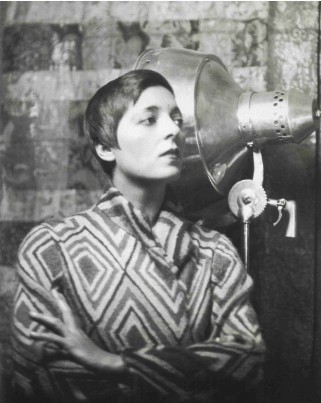
Partner Eyre de Lanux
Queer Places:
17 Rue Visconti, 75006 Paris, France
Newburn Old Churchyard, Leven, Fife, Scotland
Evelyn Marion Eleonore Wyld (June 21, 1882, Holland Park, Royal Borough of Kensington and Chelsea, Greater London, England - August 15, 1973, La Roquette-sur-Siagne, Département des Alpes-Maritimes, Provence-Alpes-Côte d'Azur, France) was an American-born textile designer and weaver who played a pivotal role in the development of modernist rug design in the early 20th century. While she is frequently remembered for her long-standing professional and personal association with the celebrated architect and designer Eileen Gray, Wyld was a skilled artist in her own right.
Evelyn Wyld was born at the at Holland-park house of Edward Wyld (1824–1887) and Ellen Elizabeth Burdon Müller Bewes (1841–1928). Their ancestral house was The Tile House, Denham, Bucks. The original Tile House was demolished in the 1950s following a fire. The site was subsequently redeveloped into a hotel and conference center, now known as Denham Grove.As reported by The Times, on March 23, 1903, at the Court held by Their Majesties the King and Queen at Buckingham Palace, the following presentations were made: Miss Evelyn Wyld, by Mrs. W. Bewes.
Wyld and Gray were childhood friends who eventually settled in Paris. In 1909, they traveled to Morocco to study traditional carpet weaving and wool dyeing techniques from local craftswomen. This experience served as the foundation for the revolutionary, abstract rug designs that would later become a hallmark of their work.
Upon returning to Paris, they established a weaving workshop at 17, rue Visconti. Wyld was the technical lead and manager of the operation, overseeing a team of weavers who hand-knotted the rugs. While the workshop is most famous for producing rugs designed by Gray, Wyld also designed her own textiles, which often featured more floral or decorative motifs compared to Gray’s stark, geometric modernist style.
Their rugs were highly regarded for their quality and avant-garde aesthetic. They were sold through Gray’s famous Parisian gallery, Jean Désert, which opened in 1922. These rugs were among the first Western designs to move away from traditional borders, favoring bold, abstract patterns that complemented the emerging Modernist interior design movement.
Around 1926 Wyld met the American artist, journalist and designer Elizabeth Eyre de Lanux and soon afterwards set up a partnership with her in the Rue Visconti workshops.
Wyld went on to work with the American artist and designer Eyre de Lanux. Together, they produced significant textile works and furniture, collaborating on interiors and exhibiting at major venues such as the Société des Artistes Décorateurs and the Union des Artistes Modernes. In the late 1920s, the pair moved to the South of France (Saint-Tropez and later La Roquette-sur-Siagne), where they briefly ran a shop called Decor.
Blessed with a haunting, thoroughbred beauty and married in 1918 to an adoring writer and diplomat—granted, Eyre de Lanux's marriage to Pierre Combret de Lanux, known as a brilliant conversationalist, was an open one—Eyre de Lanux relocated to Paris after her wedding. There, she became known as Eyre—a striking and androgynous rebranding—and drifted into the heady orbit of the lesbian heiress and poet Natalie Clifford Barney, a self-proclaimed Amazon who embraced her fellow American’s beauty, spirit, and fluid sexuality. “I not only know the way to you, but the way to bring others to you.…” a smitten Barney wrote. “A turn of your head, a turn of your soul—I am there.” Other dalliances followed, with artist Romaine Brooks (who painted her while also carrying on an affair with Barney), Surrealist poet Louis Aragon (who wrote at least one poem about her), novelist Pierre Drieu la Rochelle (he complained that he couldn’t successfully romance her away from “her impotent husband, her dykey friends”), and carpet designer Evelyn Wyld, her business partner. The amorous daisy chain also included Consuelo Urisarri Ford, a married American novelist, to whom Eyre wrote impassioned love letters decorated with nude images of them both.
Wyld’s legacy is often intertwined with the broader history of English and French Modernism. She was instrumental in bridging the gap between traditional, labor-intensive craft—such as the techniques learned in North Africa—and the clean, functionalist demands of modern architecture and interior design. Her work, including collaborations with Gray and de Lanux, remains highly sought after by collectors of 20th-century decorative arts, appearing in prestigious auctions and museum collections.
References:
 Sapphic Modernities: Sexuality, Women and National Culture by Laura Doan and Jane Garrity |
 Eileen Gray and the Design of Sapphic Modernity: Staying In by Jasmine Rault |
Other references:
Support this project
This website is a passion project researched, developed, and funded entirely by me. If you find the content valuable and would like to help support the ongoing research and hosting costs, any contribution is deeply appreciated.
Thank you for keeping this independent resource alive!
My books on Amazon: Elisa Rolle's books